Posts Tagged ‘rum’

Rule 37: Blue Hawaiian

Modern Drunkard Magazine’s articleThe 86 Rules of Boozing, by Frank Kelly Rich states:
Rule 37. Try one new drink each week.
The Rule 37 series of posts chronicle my attempts to accomplish this feat every week.
For the recipes of R37s past, click the Htf do I make these drinks? tab.


There’s a monster lizard!!!


What started as a predicted “2-4 inches beginning in early afternoon” before the main blizzard event rapidly escalated when at 7am, there was a blanket of 4″+. Yeah. Apparently some sort of “microburst” which “didn’t show up on radar” hit Portland and dumped half a foot. BEFORE the actual blizzard. Awesome.

Weathermen/women should be publicly whipped when they’re this wrong.
Or take a pay cut.

I know which would be more entertaining on the 11 o’clock news.

Yes, I’ve heard it before: it’s nearly impossible to predict the weather. So… why is that a profession? Couldn’t we just throw darts at a board of weather events with about the same rate of accuracy? Or let a monkey do it? (That would be awesome.) It’s not even that they’re so constantly wrong: it’s that there’s no accountability. Why is this a magic job with no consequences for consistently poor performance?
And how do I get this job?


So, the Lady Friend and I were discharged from work at noon, and proceeded to spend the rest of the day drinking stouts, and watching The Empire Strikes Back, certainly both fine choices for a snowy afternoon. But then it was cocktail time, and something had to be done. I had already decided I wanted something with rum. And pineapple. Because screw you, snow. It’s going to be tropical in my belly.


This one comes from The Rum 1000 by Ray Foley. It’s a half decent go-to if you’re looking specifically for rum drinks, but a tad annoying, as many cocktails are named by brand. I don’t need different recipes for an Appleton Daiquiri, a Bacardi Daiquiri, a spiced Daiquiri, and several other variations. At least there wasn’t a Captain Morgan’s Daiquiri. Wait… the “spiced” one was. Ugh. I guess it was a bit of a stretch to get to 1,000 recipes. But basically a lot of them have rum and pineapple, so I picked one and went for it.


rule37bluehawaiianBlue Hawaiian
From The Rum 1000 by Ray Foley

- 1 oz white rum (Bully Boy!)
- 1 oz blue curaçao
- 1 oz coconut cream (Coco Lopez)
- 2 oz pineapple juice

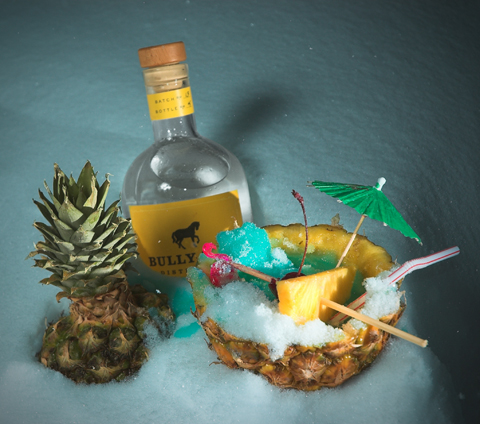
The book says to “blend with a scoop of crushed ice until smooth” and serve in “a glass.” Very detailed. I went a different route. Shake everything as normal, strain into a snow-filled pineapple cup, garnish with a cherry, pineapple slice, and a whole bunch of tropical tiki junk. Drink. Repeat until the snow stops.


Broke out the tastilicious Bully Boy on this one, and juiced up some fresh pineapple. Coconut cream makes everything taste happy (Coco Lopez has a squeeze bottle… use that. It’s much easier than the can) and blue curaçao turned everything blue-green. The pineapple cup took some doing, but was worth it just for the occasion. I wish I had made it bigger.

The drink smells… well, like sugar cookie rum, pineapple, and coconut. There’s a slight astringency from the rum, but this isn’t a complex sipper. A couple dashes of Angostura bitters would really help this along, but it’s not necessary. Somehow any drink that uses blue curaçao doesn’t seem worthy of bitters.

It tastes… well, again, about how it smells. The coconut cream is forefront in the flavor, which a choking sweetness and syrupy texture. Bully Boy rummy goodness adds to the sweet, but the booze helps cut through a bit. The pineapple just kind of hangs out in the background making everything juicy and happy. I don’t get any of the blue curaçao, though a touch of that alcohol astringency might be from that triple sec dryness.

It’s not terribly complex, but it’s not supposed to be. It’s a super-sweet tropical drink to make you forget about the accumulating snowdrifts. Sunshine in a cup. If you have enough of them, you can actually feel the deck of the cruise ship sway under your feet. Don’t fall overboard. There’s no water: just snow.

Rule 37: Beachcomber’s Gold

Modern Drunkard Magazine’s articleThe 86 Rules of Boozing, by Frank Kelly Rich states:
Rule 37. Try one new drink each week.
The Rule 37 series of posts chronicle my attempts to accomplish this feat every week.
For the recipes of R37s past, click the Htf do I make these drinks? tab.


Rum.
I wanted rum tonight.
The Lady Friend had a super awesome Manhattan (THIS version) and I was kind of jealous, but I already had my heart set on RUM. I don’t know why, but I did.

So, I started flipping through the New York Bartender’s Guide by Sally Ann Berk, where I had previously found The Million Dollar Cocktail. This book sorts by liquor, which is awesome, so I started in the middle of the rum section. There were a few interesting recipes to save for another time, but I had to start over at the beginning of the section to find this one: Beachcomber’s Gold. I’m going to assume this one was either created by, or named for (or both), Tiki drink legend Don the Beachcomber. Apparently there are other versions out there, but they’re nothing like the version I made. They do use a cool ice “garnish,” but this version is many much more easiers. You heard me.


Three ingredients. And one of them is rum. The other two are actually both vermouth, but they’re different kinds. That’s it. It’s basically a Perfect Manhattan/Martini with rum instead of whiskey or gin. “Perfect” in these cases means using equal parts dry/white and sweet/red vermouths. A Martini uses dry vermouth, a Manhattan uses sweet, and a “perfect” version of either uses both dry and sweet. Got it? Great. Drink time.


Beachcomber’s Gold
From the New York Bartender’s Guide

- 2 oz light rum (Bully Boy)
- 1/2 oz sweet vermouth (Martini & Rossi)
- 1/2 oz dry vermouth (Martini & Rossi)

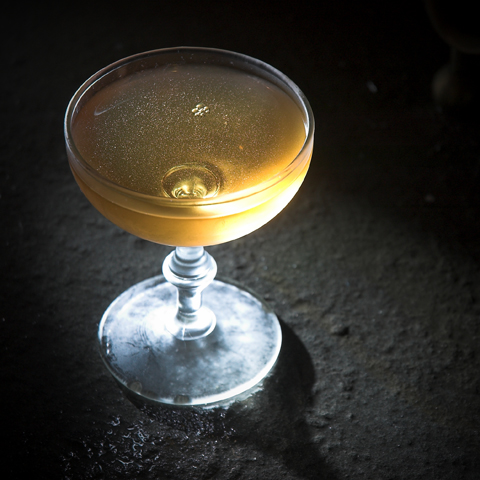
The book says to shake it, and strain into a cocktail glass full of crushed ice. Nuts to that. I’m treating this like a Martini/Manhattan or any other spirit-only drink, which means STIRRING it. Since she got that first part wrong, I’m also going to ignore that bit about crushed ice, and serve it UP, in a chilled cocktail coupe. There was no word on garnish either, but with rum, a lime peel might work nicely. I left it plain this time.


Broke out the Bully Boy rum for this one. The recipe is for a light rum, but the Bully Boy has tons of flavor. Like a molasses-coated sugar cookie spread its legs, grunted, and gave birth to a bottle of rum. It probably wasn’t the right type of light rum to use for this, as the flavorful Bully Boy tends to overwhelm things, but with only vermouths as the other ingredients, I figure I may as well put something tasty in there. The drink does have a lovely golden hue (hence the name) as the reddish sweet vermouth is diluted by the faint yellow dry vermouth and clear rum.


The drink reeks of the aforementioned sugar cookie offspring, with a touch of grapey wine-ness underneath. This is a brand new bottle of sweet vermouth, and the difference is apparent. Vermouth is a wine, and tends to lose its aroma and flavor after about a month. Keep it in the fridge after opening, but unless you power through Manhattans and Negronis like I do, buy the little 375ml bottles so you don’t feel too bad about throwing any unused remains out at the end of the month.

The taste is a wash of that sweet blackstrap rum up front, with a pleasant warm alcoholic tingle. Interestingly enough, the vermouth strikes back in the middle of the taste, oozing in with a syrupy dark grape and lightly floral essence. I really didn’t expect the wines to put up a fight against the rum, but it really works out well. The vermouths take the sting out of the spirit, leaving behind the flavors, while adding their own grapey contributions. This is certainly a grown-up cocktail, though I would caution that the same recipe with Bacardi will not be terribly exciting. Having had the “perfect” version, I’d like to go back and try both a sweet and dry version of this drink. My guess is that the sweet will have a nice dark syrup to play with the rum’s spice (oooh… especially with a dash or two of Angostura), whereas the dry version will be more akin to a lighter, floral concoction, like the Presidente without the grenadine. I’d go with orange bitters on that one and see how things play out.


Well there you go. I just gave you three cocktails for the price of one. Bunch of moochers. Go make one! NOWS.


The Lady Friend grudgingly tried the recipe and offered the following pearls of wisdom: “I smell the Bully Boy, the cupcakes, rainbows, and all that good stuff. Hmmm. I immediately get the grapey vermouth, but I can pick up some of that sweet Bully Boy. It’s alright. I wouldn’t drink it, but… *shrugs* It’s an interesting cocktail, but I wouldn’t choose it.”


Great. Thanks.

Rule 37: Three Miller

Modern Drunkard Magazine’s articleThe 86 Rules of Boozing, by Frank Kelly Rich states:
Rule 37. Try one new drink each week.
The Rule 37 series of posts chronicle my attempts to accomplish this feat every week.
For the recipes of R37s past, click the Htf do I make these drinks? tab.


So Squirrelfarts has been a bit lax on the posts lately. Mostly all Rule 37 cocktails. Well, the thing about that is the official primary Squirrelfart photographic device (um, my camera) had a bit of a fall, and it took Nikon over a MONTH to repair it. You know how some people wear a watch every day, then suddenly forget to put it on one day, and they’re all out of sorts and claim to feel naked? That’s what I’ve been like for the past MONTH. And it’s really put a damper on various Portland boozing adventures (well, there are still adventures) because if I’m going to do a particular distillery/brewery/bar/what have you then I’m going to do it right, with a proper review and proper photography. The past several Rule 37s have been photographed with the Lady Friend’s bright pink Sony CyberShot, which is all well and good except I can’t do a thing about the lighting. Quite challenging to use natural light when my normal operating hours are rather nocturnal. But the real camera is back, and with it, proper pictures. I hope.


“What a piece of junk!”
She may not look like much, but she’s got it where it counts, kid.
I’ve made a lot of special modifications myself.


So yeah. Expect a bit more variety coming from Squirrelfarts HQ. Plus there’s a large backlog of things I still have to actually write about like Blatant Brewing, Newport Storm Brewery, drinking at the oldest tavern in America, more Milwaukee shenanigans, and a German absinthe review which came in a package with cool foreign words on it like “luftpost” and “zusatzleistungen.” What an elegant language.


Anyway, tonight’s cocktail was going to be something tropical once more, as it is still 80 or so degrees inside, incredibly humid, and torrential downpours outside. Who knew that Maine had such an equatorial climate? It was going to be the Bacardi Cocktail, with all its associated legalities, but then I sliced a lemon instead of a lime, and had to do some scrambling. While perusing rum drinks in the Esquire drinks database (featuring the venerable David Wondrich) I came across the Three Miller, which I had added to my “to-drink” list awhile back. Turns out there’s a bit of history there.

Paraphrased from Wondrich’s writeup and various other sources, the gist is that during Prohibition, the US stated that International Waters started at a point three miles from land. So, all the boozers and rum runners would simply sail out three miles and have a party. Or pick up some booze to bring back. The Coast Guard caught on an eventually upped the limit to TWELVE miles, but there was already a cocktail named for the original distance, The Three Mile Limit. That got shortened to the Three-Miler, and someone (Harry Craddock) probably picked up a typo somewhere and began calling it the Three MILLER. Strange.


Three Miller
From Wondrich’s Esquire Drinks.

- 2oz cognac
- 1 oz light rum
- 1/4 oz lemon juice
- Dash of grenadine


Wondrich’s recipe switches from ounces to teaspoons, so I’ve done the conversion for you. I hate when there’s two different units of measurement. Put it all in a mixing glass, shake it, and strain into a cocktail glass, preferably chilled. Some recipes flip the amounts of rum and cognac, and some others suggest a cherry garnish, but I went with Wondrich on this one.


Well, there’s three ounces of liquor in this one, and not much else. Let’s see what happens.

The nose is all booze. Mostly the grapey darkness of the cognac. The rum I used (DonQ) isn’t particularly flavorful, so it’s hard to get any sort of aroma from it as well. The taste is pretty much what you’d expect: a mouthful of cold cognac, with a little rum bite to it. Very boozy, but it burns off quickly. The little hint of lemon and grenadine sweetness aren’t so much there in the flavor, but rather in the roundness of the drink. Without them the booze burn would linger throughout the finish, but as-is they take the edge off. The grape flavor of the cognac lingers in the mouth, and is actually quite pleasant. Though I prefer my cocktails a tad more balanced, this one wasn’t bad. A bit more powerful than modern tipples, but cold, tasty, and full of booze. Which is pretty much all I wanted tonight.


Rule 37: Mister Christian

Modern Drunkard Magazine’s articleThe 86 Rules of Boozing, by Frank Kelly Rich states:
Rule 37. Try one new drink each week.
The Rule 37 series of posts chronicle my attempts to accomplish this feat every week.
For the recipes of R37s past, click the Htf do I make these drinks? tab.


No, not this:


or this:


…even if it rocks in a mid-80s power ballad sort of way.

Nope, tonight’s Rule 37 comes courtesy of BarNoneDrinks.com, a site I stumbled upon while looking to see if last week’s Rule 37 had a name. I was searching for drinks that combined white rum and brandy, and found several other options. While we did the rum/brandy thing last week, with great success (after some tweaking), this recipe seems quite tasty, and a tad more summery. Though it’s hard to beat a Daiquiri variation for a warm weather drink, the use of orange, lemon and lime juice, with some grenadine, makes for a very pleasant tipple. I did find numerous online references to the drink, (and strangely, they all actually agree on the ingredients) but I couldn’t find any specific history, or why its got that name. It could very well be named for the Fletcher Christian in Mutiny on the Bounty, but could also just be some random name. Let’s give it a whirl.


Mister Christian
From BarNoneDrinks.com

- 1 1/2 oz white rum (here comes the Bully Boy again)
- 1/2 oz brandy
- 1 oz fresh orange juice
- 1/2 oz fresh lemon juice
- 1/2 oz fresh lime juice
- 1 tsp real grenadine

Shake it up, strain it out. Use a chilled cocktail glass. No garnish specified, but I was feeling fancy and added a big ‘ol orange swatch, which I flamed over the top.


Here’s a tip: if you don’t keep cocktail glasses in the freezer (like I do) you can quickly chill one down while you make the drink. Fill a cocktail glass with ice, then pour in some cold water. Let it sit there while you mix and shake your ingredients. When you’re ready to serve, dump out the ice/water, and pour in your drink.


Well, thanks to the flamed orange peel, it smells orangy, mixing with the sugary goodness of the Bully Boy. It has a creamsicle aroma, and is quite inviting. The taste, however, is not so creamy. Bully Boy up front, with a slight touch of that dark, raisin sweetness from the brandy, though as with last week, I’d like to taste more of it. The medley of citrus fruits bounce between varied levels of tartness, with the lime adding a snap, the orange sweetening and rounding the drink, and the lemon playing a referee in their midst. I went with a healthy squeeze of grenadine from my bottle, which certainly changed the hue of the drink over towards a solid orange, but the taste isn’t very apparent. There’s already plenty of flavor going on, and the grenadine is content to sit quietly in the background. Overall the drink is tasty, but too sweet, and thus, not as thirst-quenching as a good Daiquiri, Tom Collins, or G&T would be. It could honestly use a bit more bitter/tart, or booze, to counteract the juices. It would probably be lovely served in a collins glass and topped with soda to even things out.

The Lady Friend expected it to be really sweet, and it was more tart than she expected. That might be due to a slightly overripe lime. “I’m really curious to taste what it would be like without the Bully Boy.” A valid point. “A less-sweet rum might work better with this, but it wouldn’t be as fun without the Bully Boy.”


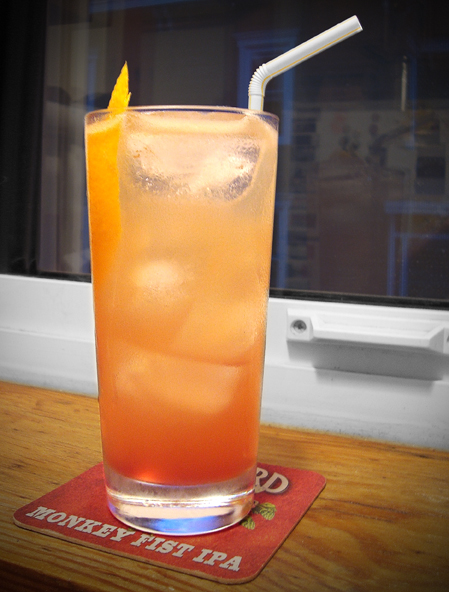
UPDATE: So, I made another one. Tried the Collins version, which means basically making hte original recipe, pouring into a tall/chimney/highball/Collins glass filled with ice, and topping with soda water. Disclaimer… the recipe makes rather a lot of liquid. Two ounces of booze and another two ounces of fruit juice, plus a splash of grenadine and some water (water is added to a cocktail through dilution when you shake or stir a drink. It’s pretty important). So in my ice-filled collins glass, it came pretty much to the top. No problem… just take a heavy quaff and make some room for the soda water. I took the level down by about 1/4 to allow for some bubbly fizzy wizzbang water. Another big swath of orange peel (trim off as much of the white pith as possible) for a garnish and a straw. Yes, Rule 48 of the 86 Rules of Boozing states that “Men don’t drink from straws. Unless you’re doing a Mind or Face Eraser” though I take that rule with a bit of flexibility for tall drinks which need the straw to a) stir occasionally and b) drink the bottom depths of the drink without getting a face full of ice.


The Mister Christian Collins noses with a light orange aroma. Not quite the creamsicle sensation of the straight version, but very nice and light. The taste is about what you’d expect… Bully Boy, citrus fruitiness, and a carbonic fizz. It’s not bad at all. Again, I’d want more brandy for an added flavor component, and the lime, lemon, and orange resume their previous roles, though somewhat diminished by the bubbling dilution. The soda water does add a liveliness to the drink, and it helps lighten up that previous sensation of cloying sweetness. It’s quite nice. I like both versions, but the Collins variation is a touch more summery, with the same booze kick.


How do you like that? As with last week, it’s like getting two drinks in the same post! Pick your poison, or try each one and see what works.

Rule 37: The Portland Daiquiri

Modern Drunkard Magazine’s articleThe 86 Rules of Boozing, by Frank Kelly Rich states:
Rule 37. Try one new drink each week.
The Rule 37 series of posts chronicle my attempts to accomplish this feat every week.
For the recipes of R37s past, click the Htf do I make these drinks? tab.


Ah, the first official Rule 37 in the new Portland, Maine SFHQ!

This one started with a previous Rule 37 involving both brandy and rum. The Bacardi used in that one was completely underwhelming, but it did make me think of the possibilities between the two spirits. Now that my Bully Boy was back in my rummy little hands again, it was time to make a summery drink to combat the moist horror of early July.

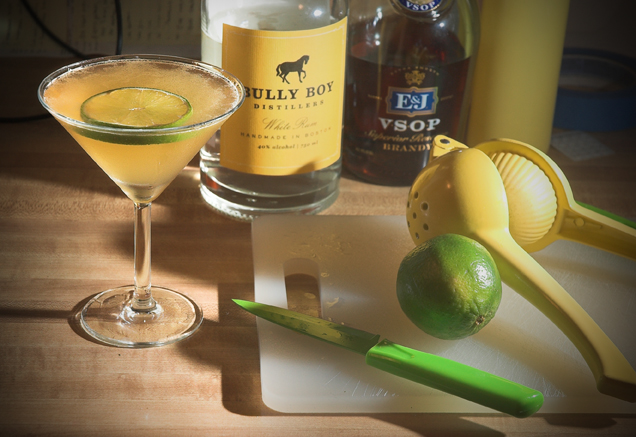
So, we’ve got a variation of a Daiquiri. It’s kind of like Between the Sheets and/or the Boston Sidecar, but both of those use triple sec, whereas I went with (raw) simple syrup as the sweetener here. My thinking was to start with a Daiquiri base and add brandy, rather than start from a Sidecar and add rum (which is a Boston Sidecar). I’m sure this one has a proper name somewhere, but I couldn’t find it. If you know what this drink actually is (besides awesomely tasty) let me know. But until then, I’ll just call it a Portland Daiquiri, in honor of the new digs.


The Portland Daiquiri

- 1 oz white rum (Bully Boy)
- 1/2 oz brandy (good ol’ E&J)
- 1 oz fresh lime juice
- 1 oz raw simple syrup

Mix em together, shake good and hard. Serve in a chilled cocktail glass with a lime wheel float.

In case I haven’t mentioned it before, to make raw simple syrup (excellent with most rum drinks) just mix one part raw sugar with one part hot water until the granules dissolve. It adds a lot more depth to your sweetener, and is even healthy!*

*Dude, it’s probably not healthy like at all, but still, likely better than the bleached, refined white sugar.


So, it noses with the characteristic Bully Boy bouquet of sugar cookies and sunshine up front, but a syrupy sweetness underneath. Yum.

The taste? Oh, that’s good. Dark and sweet. The Bully Boy is of course at the forefront, but there’s a dark, alluring sweetness underneath.

The brandy really helps create some new flavors, with a hint of syrupy grape, almost a raisin quality. Though it’s tasty, I’d love to add a touch more brandy to see what happens. This is miles away from the silly Bacardi cocktails of the past few Rule 37s. There’s almost a syrupy, slightly mouthcoating texture, with a fresh lime tart to keep it from getting out of hand. It’s just not quite what I wanted. This one slides down a little too easily, and could stand to be a bit more boozy. I think I’ll give it another try while upping each spirit by double.


The Portland Daiquiri #2
UPDATE: New recipe.

- 2 oz white rum (BBoy)
- 1 oz brandy (E&J)
- 1 oz fresh lime juice
- 1 oz raw simple syrup

Uh, yeah. Do what you did before. Shake it all up, strain into a chilled cocktail glass. Plop a lime wheel in there. Drink it.


Ok. Certainly boozier, but not unpleasantly so. There’s still plenty of flavor from the BBoy, and that dark syrupy grape from the brandy comes to play as well. The two get along quite well, with lime and raw sugar rounding it all out. This is MUCH more enjoyable. The first version was simply too sweet. Well, actually, the first version was quite tasty, but it needed more of a kick to get it into a better flavor balance. Upping the booze content is one option when dealing with a overly sweetened drink, and in this case it paid off. Of course, you COULD simply use less sweetener, but I prefer adding more booze.

The Lady Friend gives this version her approval saying: “This one is much better balanced. You can appreciate the different spirits in it for what they are.”


Yeah. Try the second version. It simply works better.

Rule 37: The Flying Tigre Coctel

Modern Drunkard Magazine’s articleThe 86 Rules of Boozing, by Frank Kelly Rich states:
Rule 37. Try one new drink each week.
The Rule 37 series of posts chronicle my attempts to accomplish this feat every week.
For the recipes of R37s past, click the Htf do I make these drinks? tab.


It’s been a hectic week. And like six thousand degrees out.

Lord, beer me strength.


But for now, a cocktail will do just fine. The Lady Friend tracked this one down. I’ve been working with a limited liquor palette due to a relocation of my bar and other worldly posessions, so like last week’s post, I’ve had to make do with the Bacardi Light/White instead of something infinitely tastier. So, the Lady Friend, being wikid smaht, went to the Bacardi website and found this week’s recipe. Here’s the history of the drink, taken from that site:

“Here’s our adaptation of a recipe featured in the 1949 edition of Esquire’s Handbook for Hosts. The originator is unknown, but the recipe is said to have been created in Cuba in 1942. Which explains the, erm, unusual spelling. The Flying Tigers were the US air squadron assigned to help the Chinese defend Rangoon during the darkest days of WWII. Despite being outnumbered by the Japanese, they held out for months and their bravery became the stuff of legend. Strangely enough, despite their name, the Flying Tigers were famous for the cartoon shark faces that they had painted onto the noses of their planes. Oh well, tigers, sharks… whatever works, right?”
Courtesy of Bacardi


The Flying Tigre Coctel
They had some silly measurements on the Bacardi site, so I’ve paraphrased it for easier mixing.

- 1 1/2 oz Bacardi white rum
- 1 oz Bombay Sapphire gin (we had Bombay London Dry)
- 1/4 oz simple syrup
- 1/4 oz grenadine
- 2 dashes Angostura bitters

Mix it up, shake it up, pour it out. They suggest an orange zest garnish, but the picture on their website has a lime wedge. We opted to leave the garnish out entirely.


Oh, and in case you’re wondering, Bacardi owns the Bombay Sapphire brand. Hence, their specific ingredient list.


It’s got an interesting smell. The gin is there, and there’s a sweetness, but also that Angostura spice. It almost smells like ginger. The Lady Friend mixed this one while I was laying down the worded groundwork, and I happened to catch her dashing in the bitters a little heavy-handededly. But I like bitters, so that’s not the end of the world. This is a decently boozy tipple, and the Angostura should add some flavor in there.

The taste starts off with a sweetness, but quickly goes towards the antiseptic burn of the Bacardi. Angostura is the predominent taste here, again because a bit more than necessary went into it. However, without the bitters, there really wouldn’t be much left to this one. At least, not with this brand of rum. Some good blackstrap would transform this drink. The gin really seems to get lost. I’m not getting much of it at all, aside from contributing to a touch of juniper pine on the finish. But it’s very subtle. With another sip, there IS a bit of gin in the overall flavor, but again, it’s slight. There is some juniper on the burp, which is a very effective way to taste the spirit. As with last week’s Boston Sidecar, the Bacardi white/light rum is non-existent flavor-wise, despite their proclamations of “Superior” branded rum.


As for the Lady Friend, she said that the “smell is initially gin, but I can pick up the pomegranate [grenadine].”
The taste was “initially, not too bad. I definitely get that gin, and Bacardi burn in the back. The first sip is smooth and sweet in the front, but gets that Bacardi burn in the back and the gin pineyness. It’s about what I expected, I guess. I think this could be drastically improved with better ingredients, like Bully Boy rum and GTD gin.

By jove, I think she’s starting to get it. Better ingredients equals better cocktails.

Rule 37: The Boston Sidecar

Modern Drunkard Magazine’s articleThe 86 Rules of Boozing, by Frank Kelly Rich states:
Rule 37. Try one new drink each week.
The Rule 37 series of posts chronicle my attempts to accomplish this feat every week.
For the recipes of R37s past, click the Htf do I make these drinks? tab.


This week’s Rule 37 tipple is a twist on a classic, though has become a classic itself.

The Boston Sidecar is a normal Sidecar with rum in it. It’s that simple. But what does rum have to do with Boston? Back in the day, (like, Colonial days), Boston was a rum town. It was the spirit of choice for the Colonies, due to the Triangle Trade. The the cranky pants Brits decided to tax everything, and ruined the whole deal. That’s when the Colonist looked around and said “Screw that. We’ll just make booze out of crops instead of sugar cane.” It became the turning point for whiskey, specifically rye, to take over as the drink of choice for America.

The Lady Friend suggested this recipe, and the one she found called for lemon or lime juice. A Sidecar is equal parts brandy (or cognac), triple sec, and lemon juice. Well, that’s one way of making it. Other versions call for up to eight or even ten parts brandy to the other ingredients, but I think they’re way too boozy (though Wondrich’s version isn’t too out of control). It’s just brandy with a little flavoring at that point, like a dry Martini. I prefer the “French School” of equal parts. Anyway, our discussion dealt with which citrus juice we should use. A normal Sidecar uses lemon, and the general rule is that lemon pairs well with brown spirits (brandy, whiskey) whereas lime goes with clear spirits (gin, tequila, vodka, light rum). Since the Boston Sidecar uses a full shot of white rum, she made her version using lime juice, pairing it with the rum as in a Daiquiri. I made mine with lemon, and we compared the two.


The Boston Sidecar

- 1 1/2 oz rum (white or aged)
- 1/2 oz brandy or cognac (used brandy)
- 1/2 oz triple sec
- 1/2 oz lemon or lime juice

Shake the ingredients. Shake-ah shake-ah shake. Strain into a chilled cocktail glass. I garnished my lemon version with a lemon spiral. I’d suggest using a lime wheel for the lime juice version. Float either on the surface of the drink. You can also opt for a sugared rim, though I tend to avoid it.


Lemon Version
Nose:
The nose is certainly lemony (the garnish comes into play here) but with elements of light rum, dark brandy, and astringent triple sec. Time for a taste.

Taste: Well, it’s slightly mouth-puckering. There’s a lemon tart and boozy quality to it that dries the mouth. I usually get that effect with drinks that contain triple-sec. The brandy adds an interesting note, but the rest of the drink reminds me how accustomed to big-flavored rums I’ve gotten. I went with Bacardi on this one, because my beloved Bully Boy rum is so flavorful that it tends to overwhelm cocktails with sugary goodness. It’s tasty, but the use of Bacardi in this one allows some other flavors through. While I wouldn’t call this a dry drink, there is a dry quality to it, due to the astringent Bacardi and triple sec. The only flavors I can really pick up on are the lemon, brandy, and a hint of orange. In other recipes, they call for an aged or golden rum, which would certainly have more flavor than the Bacardi light/white used here. Do yourself a favor: use a rum with flavor. Hey, that’s a good slogan! PATENT PENDING.


Lime Version (Not pictured: that’s another shot of the lemon version to the left)
Nose: Whoa. Way different. Lots of lime tart. It smells like a beefed-up Daiquiri, with the orange essence of triple sec coming out a lot more, and the brandy adding a dark element once again.

Taste: Again, there’s a dry quality to the drink, but the lime adds MUCH more flavor here. Since the Bacardi seems to be doing nothing but adding booze, the lime really takes over and mingles quite well with the triple sec, as in a Margarita. The pairing of rum and lime is a classic for a reason. The brandy here adds a dark warmth to the drink, which leads me to believe that adding a touch of it to a regular Daiquiri would be a fine idea. I hate to concede defeat, but it seems the Lady Friend’s version is the way to go with this one.


The Lady Friend says that her lime version is much more tart whereas the lemon is a bit more sweet. I’m not sure it’s sweetness, but rather a less flavorful citrus. She thinks the brandy comes through more on the lemon version, which I agree with, but I’d trade that hint of brandy for the flavor of the lime tart. I think this drink could be really complex and amazing, but it’s pretty mediocre with Bacardi. Use something tasty instead.

The Bully Boy Speakeasy

So, last Friday night I went to Bully Boy’s speakeasy party.

It was pretty sweet.

Let me explain.


A couple months ago, the Bully Boys started dropping hints on Facebook and Twitter that they were going to throw an exclusive bash to celebrate their one year anniversary of the distillery. Old-timey garbed dudes started showing up at local bars, and posters appeared around town, each with a QR code to scan, which took you to a website. From there you registered, and got a secret entry password to the secret location (which wasn’t revealed until a week before the party), in the style of old speakeasies. I still have no idea what my password actually was, since the audio file kinda slurred the last word. Black gull? Black gulp? Black colt? Not a clue. Something like that. So I planned to equally slur the last word to gain entry.

Finally, the location was revealed: the Waterworks Museum out in Chestnut Hill. It’s located on the reservoir, and was the original municipal water pump station for the City of Boston until the 1970s, when the source was switched over to the gigantoid Quabbin Reservoir out in Central MA. The Lady Friend and I arranged a logistical puzzle (she was coming from Seaport in the city, whereas I was coming from work, then into the city on the T) and met up on the green line, carefully avoiding the horror of the B train through Boston University. Seriously, it stops every 30 feet out there. Ridiculous. After snagging a C train to the Reservoir stop (they were running shuttle buses after Reservoir, so we totally lucked out on that one) we had a brief stroll around the Chestnut Hill Reservoir itself, and over to the museum. Entrance was gained via the side door, and in we went. They actually never even asked for the password.


I bet it’s haunted.


Just inside the door, we ran into co-Bully Boy Will Willis, and chatted for a bit before continuing farther in to the museum. Holy snotrockets. This place was HUGE. Three story-high machinery lit with accent lights towered above, while the DJ pumped out remixes of classic Prohibition-era ditties (before switching over to some sweet Ace of Base). Several bars were set up throughout the machine room, and we sidled up to one to get a few drinks. I led off with a Mojito (pre-mixed, but Mojitos are a pain to make) and the Lady Friend went with the Rough Rider, the whiskey cocktail. After our traditional Bully Boy cheer “BULLY!” We took in the small details while sipping our drinks: the cigarette candle holders (real cigs… I checked), Bully Boy branded coasters, match books and empty liquor bottles as flower vases, all arranged on wooden casks. The Bully Boy logo projected brightly onto the machine room floor, and the guests, some decked-out in Prohibition-era attire, meandered in to clutch highball glasses and stare at the mechanisms looming above.


And jamming out to some sweet tunes. I did indeed see The Sign. And it opened up my eyes.


Our next round of drinks worked out quite nicely as the Rule 37 for the week:

The Commodore

- 2 oz Bully Boy White Rum (our pour was at least double that, but I’m the last to complain about a heavy-handed bartender)
- Top with Night Shift Brewing Trifecta (Belgian-style pale ale)
- Garnish with lemon wedge

Um. Pour a whole bunch of rum into a pint glass and top with the Night Shift. Plop a lemon wedge in there and drink it.


Whoa. It was certainly boozy. Trifecta is a 7% abv beer to begin with, so there’s a decent amount of punch in this pint. Yes, it’s more of a beertail than proper cocktail, but this totally still counts. Nosed with a strange mixture of sugary blackstrap rum and a Belgian-y sweet & sour aroma. The Bully Boy certainly overpowers the brew, but it’s still in there with a faint cry of “I’m not dead yet!” The taste? My notes read “oh that’s strange.” A Belgian fruity and sour note, offset by the sugar of the rum. There’s certainly a boozy astringency as well, and an almost grapey sour quality to the Belgian. I’d have to try the beer straight to get a better idea of it, but the two did get along quite well.

As we slurped our Commodores, the OTHER Bully Boy, Dave, came over and chatted with us for a bit. As we were talking, Michael O’Mara, co-founder and brewer of Night Shift, walked up, fresh from delivering kegs at the American Craft Beer Festival, and we were introduced. His altered suggestion for the drink was a shot of Bully Boy rum, topped with the Trifecta and lemon wedge, but served in the skinny highball glass over ice. It probably would have been a more manageable alcohol content, and a better blend of flavors, but I was satisfied with my big ol’ pint o’ booze.


The Lady Friend and I stayed a bit longer, exploring the museum, tasting more cocktails and having some snacks. We headed out as the party got REALLY crowded, and made our way back to the T, complete with Indiana Jones-style lawn sprinkler evasion maneuvers. While waiting for the God-forsaken T train way out in the wasteland of Cleveland Circle, we observed a pointy kitty (large rat) shuffling and snuffling along the rails. The Lady Friend, unperturbed by our new acquaintance from the Order Rodentia, and perhaps feeling a bit cocktail-laden, insisted on sitting on a junction box clearly marked “Wet Paint.” Luckily for her, it had dried by that point leaving khakis unblemished for the trip home. Bully!

GrandTen Distilling

Holy crap.

There’s ANOTHER craft distillery IN Boston.

!

I had no idea.

I stumbled on an article on BostonHerald.com that described a new distillery in South Boston called GrandTen. An email was immediately sent, and in a short amount of time I received a reply from co-owner Matthew Nuernberger, who graciously invited me in for a visit.

Here we go.


Yes, there’s a distillery in there.


GrandTen Distilling is located on Dorchester (Dot) Ave. in between the Andrew and Broadway T stops. It’s easily walkable from each. However, the entrance itself a bit tricky to find. There’s the tan “Addison Wellesly” building at 383, but it’s all small offices inside. Next door, at 371, there’s a series of green buildings, but that’s too far. GrandTen is actually located BETWEEN those two buildings, down a driveway and hidden in the shadows of the overhanging building. Did you miss it? Yeah, me too. Several times. It does give it a slight speakeasy feel, where you only gain entrance by knowing where the door is before you go. Once entering (look for the banner hanging overhead) I knew it was the right place when a copper pot still winked at me from across the room. I was just glad to get out of the rather warm and odoriferous waft of industrialized Dot Ave.


That’s more like it.


The distillery is located in a historic Boston building, which was once the home of the South Boston Iron Company, an iron foundry established in the early 1800s by metallurgist Cyrus Alger. Back then, the building sat on South Bay, which has since been filled in, and was one of the premiere foundries of the day. The first gun ever rifled in America was produced at the foundry, and they continued to provide munitions and arms to the US Government through the War of 1812. When steel became the metal of choice, the foundry switched to producing wire, and the spectacle of sparks and molten metal became a must-see tourist attraction for Boston.


Inside it smelled like the bran/molasses treats my mom bakes for her horse critters. It reeked of molasses. Which meant that there was rum being born. I met Matt, and he showed me around their setup while co-owner Spencer McMinn busied himself by trying to infuse hickory smoke flavor into a jug of vodka. More on that later. GTD runs a 50 gallon pot still, currently electric. It’s an “eau-de-vie” still with a larger dome with more copper surface area (copper is essential in distilling; it neutralizes some of the byproducts) and allowing more flavors through the distillation process. Their column is quite a bit shorter than others I’ve seen, though again, this means less separation and more flavors in the final spirit. They’ve had it for 16 months, but it’s only been operational since November of 2011. As with Bully Boy and Ryan & Wood, GTD had to wait for months and months while their distillery plans were approved, equipment was acquired and installed, though mostly it was all zoning and licensing nonsense. Since GTD falls under stricter Boston zoning (whereas Bully Boy had some leeway with their industrialized Newmarket location) they waited two months just for their first rejection, and another three months for the appeal. It takes a long time to convince the government that you’re a legitimate business making a real product, especially when booze is involved.

The starting point for all the GTD products is neutral grain spirit that they purchase, meaning that they do not mash and ferment their own grains, but begin with a odorless and tasteless spirit. From there, it’s distilled with botanicals for their gin, or infused with peppers and smoke for their vodka. The rum is open fermented from molasses and uses a process called “stripping,” which means the spirit is essentially distilled twice to give it the characteristics and flavors they’re looking for. The neutral grain spirit, or “eau-de-vie” (“water-of-life”) method saves time and resources for a small distillery by giving them a base spirit to begin crafting their products from, rather than mashing and fermenting wheat, corn, barley or other grains. Currently, their neutral grain spirit is sourced from New York. It sounds like the sort of thing that might draw some criticism, like using malt extract in place of milling your own barley in the brewing world, but I have no problem with it. The end products are fantastic, so why not save a step?

GTD has several end products from their eau-de-vie method, but only one, Wire Works Gin, is currently available, in the mid-$30 range. It’s been on select shelves since April, and is making its way into various local cocktail bars. They’re working on Fire Puncher Vodka, a chipotle- and hickory smoke-infused spirit, and molasses-based Medford Rum, though this will only be sold as an aged product. They’re also playing with a few liqueurs, and there’s an applejack aging in the barrel room. Yum.


So. Time for a tasting. First up was their flagship product, Wire Works American Gin, named for the foundry’s industrial past and sporting a beautiful copper-inked label. The GTD boys wanted to make an American-style gin, not a Plymouth or London Dry, which are more of an alcohol-juniper assault. Typically the alcohol heat and overwhelming juniper flavors punch you in the mouth, but GTD wanted something else. The American-style gin is smoother, rounder, and more complex than their British brethren. Great Lakes Distilling Rehorst Premium Milwaukee Gin springs to mind as a good example of the American style, sweeter and smoother, with some more unique flavors. Ryan & Wood also makes a smooth, citrus-forward gin that I was impressed with.

The GTD boys poured a splash of their offering into a red plastic party cup, and also served up some samples of Beefeater London Dry and Tanqueray for comparison. Sure enough, the Brits were hot on the nose with a big slice of pine, and tasted the same. Wire Works nosed sweet and smooth. The pine/juniper essence is there, but very balanced and tempered. It was a much lighter aroma than the sickly perfumed London styles. The taste? My notes read “WOW. TASTY!” There’s pine, but with a sweetness, different from an Old Tom or genever. There’s almost some mint or spruce in there, and leaves a very pleasant tingle on the tongue, rather than the usual hot alcohol burn. It has an excellent mouthfeel, smooth but without being too coating. This is due to a somewhat unique (for gin) ingredient: cranberries. Spencer, a PhD-level chemist by the way, explained that the cranberries were used for their acidity, which creates a smoother mouthfeel. None of the cranberry flavors make it through the distillation, but that semi-gloss mouthfeel is great. As I’ve said before, gin is not my favorite spirit. I’m getting there, but it’s a slow process. I think Wire Works is my new favorite, even better than the Rehorst. It’s that good. Amazing.


Next, I tasted a test batch of their Fire Puncher Vodka, whose namesake, South Boston firefighter Tommy Maguire, attacked flames with such vigor that it was said he punched the fire with his bare fists. Fire Puncher is a flavored, infused vodka, so don’t expect a neutral spirit here. GTD has no interest in making flavorless spirits. Their goal with this one is to make it taste like a campfire, infusing hickory smoke, and two kinds of Chipotle peppers. On the nose, it smells like Mexican food: spicy, but with a smooth sweetness underneath. The taste starts with a smooth green pepper flavor, which moves to a bitter campfire smokiness in the middle. The pepper’s spice kicks in, and lingers throughout the finish. It’s a spirit that stays with you, but that’s not a bad thing. Though this test batch was a bit spicier than they wanted, I thought it was EXCELLENT. There’s so much flavor going on that you don’t notice the 90 proof alcohol, yet it’s not TOO hot and spicy, but rather an almost savory medium hot pepper. This one is going to make a FANTASTIC mixer, though would likely be a great sipper over rocks.


As a special offering, there was a taste of almond cordial that was still in the test phases. At 80 proof, it’s made from an almond distillate aged for 4 weeks on toasted oak spirals. This is no sugary amaretto or orgeat syrup: it’s the real deal. Pure almond flavors without all the sugar syrup. It noses with a nutty pasta quality and some slight alcoholic heat. The taste is, well, almondy. Mmmmm. Slightly syrupy, but there’s no indication of the 80 proof booze. It would also be excellent over ice, or as a sweetener in cocktails. Perfect, as Spencer described their products as being “very cocktail driven.” These guys know what they’re doing.


Finally, there was a taste of their Medford Rum coming straight off of the still. It was all at once sugary, molasses, and wonderful. Very much akin to Bully Boy’s White Rum, though GTD will be selling only an aged version. A lot of New England distilleries are going the way of blackstrap molasses rums, such as Turkey Shore’s Ipswich Rum, another craft distiller on my list to visit. There’s a rich history of these rums in the area, as rum was the spirit of Colonial America, until the Brits imposed taxes and the drink of choice shifted to whiskey. Medford Rum is named for the original Medford Rum, which dates back to the early days of Massachusetts. GTD’s version, right off the still, was incredibly flavorful, and should be phenomenal once it’s aged.


GTD is purposefully naming each of their spirits and delving a bit more into a back story for each one, rather than pushing their distillery as an overall brand offering a gin, a vodka, a rum, etc. It’s an interesting approach, and they believe the spirits should stand on their own, appealing to a wider audience. You don’t necessarily go looking for GTD gin, but when you see Wire Works on the shelf with the big London gins, it’ll be quite a bit more distinctive and unique.


Public tours and tastings will begin sometime later this summer, once their retail and tasting area is constructed. Matt described it as basically being a second business within the distillery, so they’ll need some time to get it up and running. And built. They’re doing the construction by themselves (there was freshly-laid tile when I visited), but it should be a great attraction once completed.


In case you were wondering about the name, as I was, yes there’s a story there too. Matt and Spencer’s grandfather (they’re cousins… did I not mention that?) was a hardworking guy who enjoyed his cocktails, especially gin. Family gatherings were rousing affairs where the booze flowed freely. Since he had nine grandchildren, they decided to name their distillery GrandTen, as they think he would look upon the business as his “tenth” grandchild, and love the gin it produced. I think it’s a great namesake, and with the quality spirits they’re making, GrandTen should make the old man proud. Keep an eye out for these guys and buy their booze.


Mil-wacky in March, Part 3: Great Lakes Distillery

Yet another travel series that I never seem to finish. This one tells the tales of our Milwaukee adventures in late March of 2012. We went there to do some serious drinking. Oh, and also Trevtastic got married. Yeah, some girl actually married that boy. But still, it was a good excuse to show the Lady Friend the various drinking landmarks of Milwaukee, so that’s what we did. Wistful wanderings in Wisco. Part 1 is here.
Yah dere hey.


Here we go.

This is one of the reasons I wanted the Lady Friend to come to Milwaukee.

Well, this and Trev’s wedding.

But this is also awesome.


Great Lakes Distillery. Yes, they make booze in there.


I think I visit here every time I come to Milwaukee. It used to be that you’d enter around the back, right into the warehouse portion of the building, where the actual distillery is set up, but these days they’ve got a brand spankin’ new retail shop and tasting room up front. It’s pretty snazzy. Still, on larger tours, the “old” tasting room down on the production floor is used. We entered the new tasting room, and thankfully the paint-and-drywall smell had faded since my last visit, though there was a mural still in progress. The Lady Friend and I sidled up to the bar and ordered a cocktail. GLD highly encourages having a cocktail along on the tour. It helps you pay attention. Since the Kinnickinnic Whiskey was back in stock (they were completely drained last time) I led off with a simple Whiskey Sour. I have no idea what the Lady Friend went with, though I suspect it had grapefruit juice. There are a number of cocktails available across most of their spirit lineup for about $5-$7 if I recall, though they might make you one off-menu if you’re super nice and they know how to make it. Michael led off as our tour guide this time, and the Lady Friend and I, along with one older couple, grabbed our drinks and headed down the stairs to the production floor.


I hate saying “this is where the magic happens” but a lot of good stuff is born here.


First, the history. GLD was officially started back in 2004 by a video-tech guy named, well, Guy. Guy Rehorst. He realized that there were NO distilleries in the state of Wisconsin, so he started his own. Due to licensing, permits, and just building the place, it took until October of 2006 to get their first bottle out the door (it was vodka). Since GLD began, eight more distilleries have sprung up in Wisconsin, with eleven more on the way. The craft distillery market is starting the same sort of building boom that craft beer had about 10-15 years ago, and currently they’re growing at the rate of about one new distillery in the US every month. By 2015, it’s projected that there will be 500 distilleries in the country, which means like craft beer, there’s going to be a lot more choices on the shelves. Which is awesome.

Distilling itself is fairly simple. You take, well, ANYTHING that ferments, and boil it. Alcohol has a lower boiling point than water, so the alcohol turns to vapor. Then you cool and condense it back down into a liquid, and you’ve got booze. Probably some pretty rough and firey stuff, but still booze. As Michael said “A child could do it. It’s also a felony.” Depending on what you make, there are at least a few rules in place. Vodka must be distilled at a minimum of 95% abv (right out of the still… it gets diluted down to usually about 40% abv/ 80 proof). Whiskey must be made from 100% cereal grain (wheat, rye, barley, corn… you get the picture). Brandy must be made from 100% fermented fruit (usually grapes, but also apple, pear, peach, cherry… lots of choices). Gin must have juniper berries in it somewhere. Rum must be made from 100% sugar cane (cane sugar or molasses).

Once you’ve got your spirit, sometimes you need to age it. For that you need a bonded warehouse, as described in my Ryan & Wood Distillery post. The government technically owns this part of your distillery, and you have to pay them excise tax when you take liquor out of there. It costs GLD about $3 per bottle to take their own liquor out of the warehouse to sell. This factors in to “you get what you pay for” when it comes to cheap booze. If a bottle of cheap vodka costs $6, you know $3 is automatically going towards the government for excise tax. Another $1 goes to distribution costs, another $1 to the retailer, and prob about $1.50 for the cost of the bottle. What’s left for the cost of actual ingredients? (Actually, in this scenario, it adds up to -50 cents.) The point is, a lot of smaller, craft distilleries have higher prices due to better ingredients, among other overhead costs, and the government always gets their cut.


Now that we know how to make booze (and pay the government to make it nice and legal) it was time to go taste the stuff. Since there were only four of us in the tour, we went back upstairs to one of the tables in the tasting room. Michael went through each spirit, and we got a pour in a nice little Glencairn tasting glass, a very classy touch. We tasted the year-round spirits, though there are several smaller batches produced, including a unique Pumpkin Spirit, made from Lakefront Brewery’s Pumpkin Lager, and a line of brandies (Grappa, Kirschwasser, Pear/ Eau-de-vie, and Apple).


Rehorst Premium Milwaukee Vodka Red Wheat Vodka
Nose: Sweetish. Medium heat in the nose. Very neutral.
Taste: Medium heat in the taste. Good mouthfeel with decent smoothness. Neutral and pleasing.

Rehorst Premium Milwaukee Citrus & Honey Vodka Flavored Vodka
I hesitate to call this “flavored vodka” due to the mess of cotton candy, blue raspberry, whipped cream, and other silly flavored vodkas out there. This one is made with actual lemons (the distillery staff gets to zest endless piles of lemons by hand) and Wisconsin-sourced honey. GLD actually distills the flavors together, rather than simply adding them to the spirit. No sugar is added after distillation.
Nose: Lemon Pledge and honey sweet. Very aromatic.
Taste: A tad hot, but perfectly nice. Sickly lemon, like cleaning fluid. Not overly sweet.

Rehorst Premium Milwaukee Gin “Milwaukee Gin”
GLD thinks that their gin doesn’t fit into either the London Dry or Dutch Genever categories, and calls it simply “Milwaukee Gin.” They use a very mild juniper berry, and add cinnamon, anise seed, coriander, orange peel, lemon peel, Saigon cassis, cardamon into their botanical mix. Then the twist: sweet basil, and Wisconsin ginseng. I think it’s an excellent gin. You can read more about my thoughts here.
Nose: Mild pine, sweet spruce. Sugary pine smell, with a mildly hot nose.
Taste: Sweet pine, with spiciness. Very nice. Has a little zing to it, but in an interesting way.

Kinnickinnic Whiskey Blended Whiskey
The Ojibwe word “Kinnickinnic” means “mixed” or “blended” usually referring to tobacco, but in this case is a blended whiskey made from a straight bourbon, and a 4-year-old malt whiskey produced at the distillery. They were out of this on my last visit, but Guy was incredibly gracious and got his last bottle out of his car to give us a taste. Since then, they bottled another batch, so I got another taste this time around.
Nose: Hot alcohol on the nose (it’s 86 proof and unfiltered). Mild sweet bourbon lingers below the heat.
Taste: Hot, with a slight spice. Rye? Smooth vanilla from the aging. Very Scotch-like, but lighter like an Irish whiskey.

Roaring Dan’s Rum Maple Rum
All rums need a pirate mascot, and GLD’s is no exception. “Roaring” Dan Seavey was a pirate on the Great Lakes with all kinds of adventurous shenanigans. The color varies batch-to-batch, as it’s a single barrel product (they don’t mix the barrels together). Wisconsin-sourced maple syrup used, and bottled at 90 proof. This was the first bottle I bought from GLD.
Nose: Sweet, sugar maple. Hot in the nose. Sugar cookies.
Taste: Warm burn, then sweet maple washes over. Finishes hot and alcoholic, which keeps it from getting overly-sweet. Yum.

Amerique 1912 Absinthe
GLD is one of the few domestic distilleries I can think of that makes an absinthe. I won’t get into the troubled history of the spirit here, but it was banned in the US in 1912 for various reasons, and has started to make a comeback with legalizations and the cocktail craze. It’s an interesting liquor, with a crazy story, and GLD makes two versions: Verte (green) and Rouge (red). I brought back a bottle of the Rouge after this trip.
Absinthe Verte (diluted with water, no added sugar)
All-natural color from chlorophyll.
Nose: Licorice. Black Twizzlers. The Lady Friend recalls Good n’ Plenty. A lingering sweetness.
Taste: Very pleasant. Anise taste, but drinkable after the louche. Very light alcohol kick.
Absinthe Rouge (diluted with water, no added sugar)
All-natural color from hibiscus.
Nose: Sambuca-like anise aroma. Hot alcohol, but with much more sweetness.
Taste: Licorice, but much sweeter. Almost a touch spicy. Very nice, if you like licorice (I don’t). Very drinkable even if you don’t particularly like anise flavor. It impressed me enough to buy a bottle.

BONUS!
Guy had suggested that we try their new Apple Brandy, though it wasn’t on the tasting. We went over to the bar and Michael totally hooked us up with a sample.
Apple Brandy
Made from 100% Wisconsin-sourced Heirloom apples. Spends 3 years in aged bourbon barrels so that GLD can “put bold flavors in cups.” Well said.
Nose: HOT alcohol nose with a tart apple aroma.
Taste: HOT. Sweet apple, obviously, but complex. There are layers of both sweet and tart that flow underneath. But this is one of the more alcoholic tasting of the spirits. Still, quite tasty. The Lady Friend even bought a bottle of it.

Then he made us a Jack Rose! And yes, GLD does make their own grenadine. I asked. The drink nosed a bit hot, more so than a Laird’s applejack version, but had an amazing flavor. Very apple-y, with a tart cider start, sweet sugary mid and tasty clean apple finish. Wonderful.


Retail area where you can buy bottles and bottles of awesomeness.


We spent the rest of the afternoon sitting at the bar, sipping cocktails, and chatting with owner Guy Rehorst, whom I had met on my last visit. He’s a really nice guy, and will tell you basically anything you could want to know about the distillery, or just the industry in general. I’ve been a big fan of the spirits he’s made for the past several years, and make it a point to stop by every time I’m in town. It’s great to see a craft distillery making some great products. I like a lot of variety with my drinking, and largely gloss over the big brands, as I do with beer. Instead of Bud/ Miller/ Coors, the liquor industry has Pernod Ricard, Bacardi, and Diageo. Heavy hitters. The good news? GLD is in the works to enter the Massachusetts market, and hopes to be in Boston-area shelves by the end of the year. Keep an eye out for some more tasty choices. Highly recommended.


Return top